
What if your next meaningful professional opportunity begins with a conversation that isn’t an ask? To build professional connections worldwide, you need more than a polished profile or a growing contact list. You need genuine curiosity, respect for cultural context, and a clear reason to keep the conversation going.
If your local network feels too small for your ambitions, online introductions can seem awkward or transactional. Different communication styles and time zones can make it easy to lose momentum after a promising first exchange. The answer isn’t to collect more contacts. It’s to build trust through shared interests, useful contributions, and thoughtful follow-through.
This guide shows you how to find common ground across countries and professional communities, make warmer introductions, and stay in touch without turning networking into a full-time job. You’ll find practical ways to offer value, navigate cultural differences, and maintain relationships at a sustainable pace. We’ll also look at how CaribSocial, a global professional, social, and cultural network with Caribbean roots, brings people and communities together across borders.
Key Takeaways
- Set a clear purpose for networking so you can focus on communities and conversations that align with your goals.
- Adapt your communication across cultures by staying curious, respecting language preferences, and suggesting meeting times that work across time zones.
- To build professional connections worldwide, contribute something useful before making a request, then follow up with a specific point from your conversation.
- Turn online introductions into ongoing relationships with a simple routine for checking in and sharing relevant ideas.
- CaribSocial brings professional, creative, business, and community connections together through a global network with Caribbean roots.
Why Build Professional Connections Worldwide Beyond Your Local Circle?
Worldwide professional networking means building relationships across national borders and professional or cultural communities. It gives you opportunities to learn from people whose experiences, working environments, and creative traditions differ from your own. A wider circle doesn’t make local relationships less valuable. It brings more perspectives into the conversations and communities you can learn from.
A cross-border connection might introduce a new way to approach a familiar challenge, offer insight into how an idea resonates in another community, or broaden your understanding of a field. The value isn’t limited to career advancement or business activity. Artists, business owners, community leaders, and professionals can exchange knowledge, find common ground, and learn how others bring their identities and expertise together. A Professional Network is shaped by its relationships, not just the number of people in it.
That’s why the goal isn’t to collect contacts. It’s to create relationships that can grow through respect, curiosity, and useful contributions from both sides. A genuine professional connection keeps a conversation open; a transactional exchange ends when the immediate ask is answered. If you want to build professional connections worldwide, treat each introduction as the start of a conversation, not a shortcut to a specific outcome.
What Makes a Professional Connection Valuable Across Borders?
Distance doesn’t define the quality of a connection. Mutual respect, shared interests, useful insight, and reliable communication matter more than having identical roles or backgrounds. Relationships can span countries, industries, and career stages, giving people room to exchange perspectives without expecting each person to offer the same thing.
For example, a community arts organizer in one country might explain how local stories shape an outreach project, while a digital designer elsewhere offers a fresh perspective on presenting that work online. They don’t need the same job or location to learn from each other. Their connection can grow from complementary experience and a willingness to listen.
Who Can Benefit from a Worldwide Professional Network?
Professionals may seek peer insight; entrepreneurs and businesses may value fresh perspectives on their work; artists and creators can share ideas across creative communities. Community builders may want to learn from others working on related issues. The common thread is connection, not a guaranteed job, client, partnership, or commercial result.
These relationships can also help people see their work in a wider context. A creator might discover a shared theme with a community organizer; a small business owner might learn how peers describe their work in a different cultural setting. Stay open to connections beyond your immediate field. A meaningful exchange can begin with shared curiosity, even when people’s goals and career stages differ.
How Culture, Communication, and Time Zones Shape Global Networking
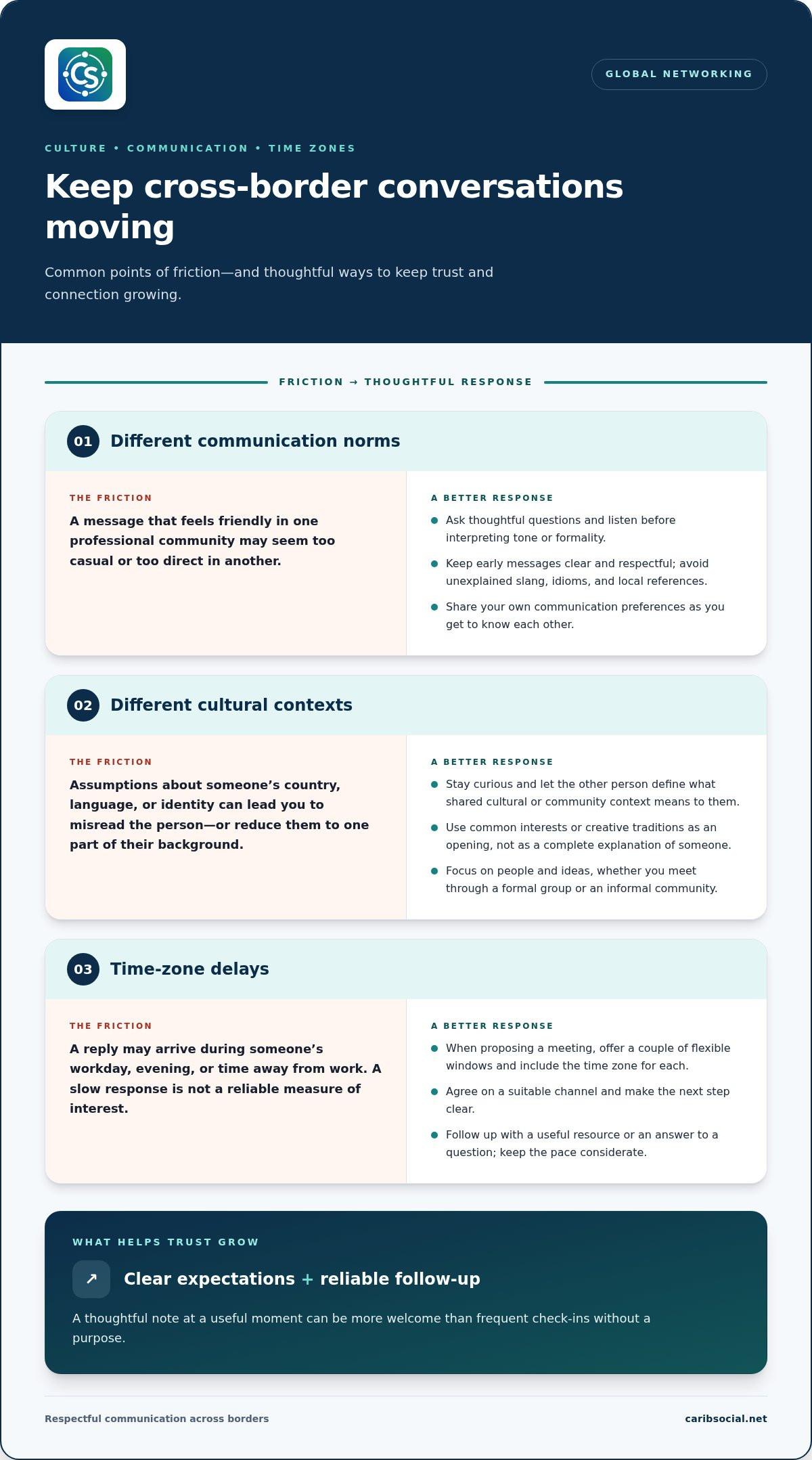
A message that feels friendly in one professional community may seem too casual or too direct in another. Communication norms vary between individuals and workplaces, so treat first impressions as a starting point, not a complete explanation. Curiosity helps you learn how someone prefers to connect without relying on assumptions about their country, language, or identity.
Shared cultural or community context can offer an easy opening. A common interest, creative tradition, or connection to a region may give a conversation somewhere to begin. Let the other person define what that context means to them. Identity can be part of a relationship without becoming the only thing you see about someone.
How to Communicate Across Different Professional Norms
Ask thoughtful questions, then listen to the answer before interpreting someone’s tone, response time, or level of formality. Keep early messages clear and respectful. Avoid unexplained local slang, idioms, and references that may not travel well. As you get to know one another, share your own preferences too, such as whether you prefer concise messages or a conversation with more background.
Professional communities and associations can provide shared context for meeting people and learning about a field. The University of Rhode Island on Professional Organizations discusses how these groups can support exploration and connection. Whether you meet through a formal group or a more informal community, focus on the people and ideas rather than assuming everyone shares the same expectations.
How to Keep Time-Zone Differences from Stalling a Connection
Don’t treat an immediate reply as a measure of interest. A message may arrive during someone’s workday, evening, or time away from work. When suggesting a meeting, offer a couple of flexible windows and include the time zone for each. This small detail reduces back-and-forth and shows you’ve considered the other person’s schedule.
After an initial exchange, agree on a suitable channel and a clear next step. You might ask whether they’d prefer email or a professional platform, then suggest following up after sharing a resource or answering a question. Keep the pace considerate. A thoughtful note at a useful moment can be more welcome than frequent check-ins without a purpose.
Cross-border trust grows through clear expectations and reliable follow-up. CaribSocial is a global network with Caribbean roots, bringing professional, social, and cultural communities together worldwide. Learn more about CaribSocial’s global network.
Common Global Networking Challenges and How to Work Through Them
Building relationships across borders can feel impersonal at first. You may not know where to begin, worry about misreading a norm, or find that an interesting exchange fades after one message. Those hurdles don’t mean you need a perfect introduction or a large international contact list. To build professional connections worldwide, start with a shared point of interest and treat the other person as a peer, not a shortcut to a job, client, or opportunity.
Use each challenge as a prompt for a practical next step:
| Challenge | Grounded response |
|---|---|
| You don’t know anyone in the community. | Join a relevant conversation and notice which ideas genuinely interest you before reaching out. |
| A first message feels awkward. | Refer to a specific post, project, or shared interest, then ask one thoughtful question. |
| The exchange feels one-sided. | Offer a useful insight or encouragement, and avoid making an immediate request. |
| The conversation loses momentum. | Suggest a clear, low-pressure next step, then allow the relationship to develop at a natural pace. |
What If You Do Not Know Anyone in Another Country?
Begin with a shared professional interest, creative field, community, or cultural connection rather than focusing on distance. Follow relevant discussions before sending a direct introduction. That gives you context and helps your first note feel personal. For example: “Your post about making community arts projects accessible caught my attention. I’m exploring a similar question in my work. What has shaped your approach?” The message names a real point of connection without assuming the person owes you a reply.
You don’t need to present yourself as an expert or explain your entire career. Offer a short introduction, say what prompted you to reach out, and leave space for the other person to choose whether to continue the conversation.
How to Avoid Networking That Feels Transactional
An immediate ask can place pressure on someone who hasn’t had time to understand your interests or intentions. Instead, share relevant context, offer encouragement, pass along useful knowledge, or make an introduction when it’s genuinely appropriate. Keep your contribution sincere. Don’t treat generosity as a hidden bargain that must be repaid.
Some connections grow into regular exchanges. Others remain informal, with an occasional conversation or shared idea. Both can be worthwhile. Respect a slow response or a polite decline, and don’t keep pressing for access. A connection becomes more meaningful when both people can participate freely, without a promised outcome hanging over the exchange.
A Practical Plan to Build Professional Connections Worldwide
A clear process makes cross-border networking easier to begin and sustain. You don’t need to travel or attend events to take part. Start with communities already sharing ideas online, and use in-person conversations when they naturally arise. The aim is steady, thoughtful participation, not a packed calendar.
- Set a purpose. Decide what you want to learn, contribute, or explore. A focus such as creative collaboration or community-building helps guide your choices without turning every conversation into a pitch.
- Identify shared communities. Look for online groups, professional spaces, cultural networks, or conversations connected to your interests. In person, notice the common topic or community that brings people together.
- Participate before reaching out. Read discussions, respond with a useful thought, or ask a relevant question. At an in-person gathering, listen first and add something connected to the topic.
- Introduce yourself with context. Mention what you have in common, briefly explain who you are, and say why you wanted to connect. Keep the tone warm and the next step low-pressure.
- Exchange value. Share a perspective, resource, encouragement, or introduction when it genuinely fits. Be open to learning too. A useful exchange doesn’t require identical roles or immediate results.
- Follow up with care. Refer to a detail from your conversation and suggest a relevant next step. Choose a pace you can maintain, whether that means an occasional message or checking in when you have something meaningful to share.
How to Make a First Introduction Feel Natural
Build your message from four parts: shared context, genuine interest, a brief introduction, and a low-pressure next step. For example: “I enjoyed your post about preserving local stories through design. I’m a creator exploring related themes, and I’d be interested to hear what inspires your approach. Would you be open to exchanging ideas here?” Make the point of contact specific, concise, and easy to respond to. In person, the same structure works as a natural opening.
How to Turn a First Conversation into an Ongoing Connection
After you speak, send a note that recalls one detail, rather than relying on a generic “great to connect.” Share a resource or offer an introduction only if it suits the conversation and the other person’s interests. Then set a reminder that fits your capacity, perhaps to reconnect when you have a relevant update. Keep it personal: a reminder should help you remember, not dictate a message that feels automated.
Start with a manageable rhythm, such as a brief weekly or monthly review of the conversations you want to continue. Adjust it as your schedule changes. CaribSocial connects professional, social, and cultural communities worldwide through a network with Caribbean roots. Explore CaribSocial’s worldwide community.
Explore CaribSocial as a Caribbean-Rooted Network Connecting People Worldwide
Building lasting international relationships is easier when you can connect through more than a job title. Shared interests, cultural context, creative practice, and community life can all give a conversation room to grow. CaribSocial brings these dimensions together as a global professional, social, and cultural network with Caribbean roots, connecting professionals, entrepreneurs, creators, artists, businesses, and communities worldwide.
That combination reflects a broader way to build professional connections worldwide: approach people as members of a community, not just as potential contacts. Someone’s work may overlap with their cultural interests or community commitments, and those connections can spark thoughtful exchanges across fields and borders. The purpose isn’t to assume what someone wants or expect a particular outcome. It’s to make space for people to find shared ground and learn from one another.
How a Culturally Rooted Network Can Broaden Your Perspective
Caribbean roots offer meaningful context for connection, while the network’s reach extends worldwide. Professional relationships can sit alongside cultural and community connections, creating a richer setting for conversation. People may arrive with different backgrounds, interests, and goals; no single identity or experience defines everyone. Stay curious about each person’s perspective, and let them decide which parts of their work and community life they want to share.
This kind of environment can also encourage you to look beyond familiar professional circles. A business owner might be interested in a creator’s perspective; an artist might find common ground with a community builder. Those intersections don’t guarantee collaboration or opportunity, but they can make room for new questions, shared learning, and relationships grounded in more than a quick exchange.
Take Your Next Step Toward Worldwide Connection
Start with one intention. Choose a professional interest, creative field, cultural connection, or community you’d like to explore. Then take one simple action: read a discussion, introduce yourself around a shared interest, or respond thoughtfully to someone’s perspective. Keep your first step small enough to feel natural, and focus on genuine participation rather than trying to make every interaction lead somewhere.
CaribSocial connects professional, social, and cultural communities across borders through a global network with Caribbean roots. Explore the network and take an intentional step toward a new connection.
Make Your Next Connection Count
Your international network doesn’t need to grow all at once. Choose one community or professional interest you’re curious about, then take a small step: join a conversation, share a thoughtful response, or introduce yourself to someone whose perspective you value. A sincere beginning gives a relationship room to develop in its own way.
To build professional connections worldwide, stay open to where common ground can appear. A professional interest may connect with a cultural or creative perspective you hadn’t considered, while a simple exchange can become a reason to keep learning from one another. Start with curiosity, and let trust grow through the way you show up over time.
CaribSocial brings people and communities worldwide together through professional, social, and cultural connections in a network with Caribbean roots. Explore CaribSocial and connect with a global community. Your next meaningful conversation can begin with one genuine hello.
Frequently Asked Questions
How can I build professional connections worldwide if I am just starting out?
Start with one professional topic you can speak about or want to understand better. Choose a community where people discuss that subject, then contribute a specific observation or thoughtful question. For example, a junior designer could ask how peers adapt visual work for different audiences. You don’t need a senior title or polished pitch. A clear introduction to your interests gives others a useful way to understand what you bring to the conversation.
Is online networking effective for building genuine international professional relationships?
Yes. Online networking can support genuine relationships when exchanges become more than profile views or connection requests. Use the format to share work-in-progress, discuss an idea, or continue a conversation asynchronously when schedules don’t align. Notice whether both people engage with care over time, rather than judging the connection by how quickly it produces a result. Digital conversations can be meaningful; sincerity and attention matter more than the medium.
Can I build professional connections worldwide without attending international events?
Yes. You can build professional connections worldwide through online discussions, professional communities, shared creative projects, and thoughtful one-to-one messages. For instance, follow a topic-specific conversation and add a useful perspective, or exchange feedback on a piece of work remotely. Travel and event attendance aren’t prerequisites. Focus on settings where people already share an interest, and choose a form of participation that fits your schedule and comfort level.
How do I write a first message to a professional in another country?
Keep it concise, specific, and easy to answer. Refer to something they shared, introduce yourself in a sentence, and ask a relevant question without assuming they can provide a favor. For example: “I saw your note about community-led design. I’m studying how teams gather local input, and I appreciated your point about listening early. What’s one question you find useful at the start?” Use plain language and avoid idioms that may not translate clearly.
How often should I follow up with an international professional connection?
Let the conversation and any agreed next step guide your timing instead of following a fixed quota. If someone said they’d share a resource, wait until the timing they mentioned has passed before checking in. If there was no plan, send one considerate note when you have something relevant to add. If they don’t respond, give them space rather than sending repeated nudges. Consistency should feel attentive, not like an obligation.
What should I include in a professional networking profile for a global audience?
Make it easy for someone unfamiliar with your local industry to understand your work. Use a clear headline, explain your role in plain language, and describe the communities or topics you care about. Add examples of your work and note what kinds of conversations interest you. If useful, state your preferred language for professional exchanges and general time zone. Avoid unexplained acronyms; a reader should quickly understand what you do and what you’d like to discuss.
How can I network internationally when I feel uncomfortable initiating conversations?
Begin with low-pressure participation instead of forcing a direct message right away. Save a few discussion prompts that feel natural to you, such as asking how someone approached a challenge or what they learned from a project. You can also respond to a group thread before starting a one-to-one exchange. Try one small interaction at a time, then reflect on what felt comfortable. Confidence can build through practice, without turning every conversation into a performance.

