
Could a smaller professional network be more useful than one with a larger audience? The number of profiles on professional networking sites can look impressive, but it does not tell you whether you’ll find people who understand your work or share your interests. The better measure is whether the community gives you relevant people, a reason to connect, and room to build relationships.
If platforms seem interchangeable, start by looking at who gathers there and what brings them together. Some support broad professional visibility; others connect people around an industry, creative practice, or shared cultural identity. The right fit depends on whether you want peers, collaborators, clients, or stronger ties to a community across borders, not popularity alone.
This guide compares professional networking sites by audience, purpose, participation, and cultural context. It also introduces CaribSocial, a worldwide network with Caribbean roots that connects professionals, entrepreneurs, creators, artists, businesses, and communities. Use the criteria below to narrow your options, then choose one practical first step toward purposeful connections.
Key Takeaways
- Choose professional networking sites based on the people and community you want to connect with, not audience size alone.
- Compare each network’s purpose and culture with your professional, creative, entrepreneurial, or social goals.
- Turn a networking goal into a clearer choice of people, connection context, and platform fit.
- Different network types serve different needs, from industry relationships to interest-based connections and event-centered introductions.
- Explore how CaribSocial brings professional connection and cultural community together, rooted in the Caribbean and connected worldwide.
What makes professional networking sites useful beyond a contact list?
A contact list stores names. A professional network helps people find one another through shared work, interests, industries, or communities, and gives those relationships room to develop. Its value is not simply the number of profiles it contains. It is the context that helps you discover people whose experience or perspective connects with your goals.
A professional network is a community where people discover and develop work-related relationships through shared interests, goals, or professional context. This distinguishes it from a general social feed, where professional connection may be incidental. The Professional network service entry outlines the category and its uses. The practical value of a particular site depends on who participates and how easily members can find common ground.
How professional networking sites differ from networking tools
A networking site brings people together. A networking tool helps an individual manage the work of staying in touch. Contact databases, email organizers, and outreach tools can help track names, conversations, and follow-ups, but they do not necessarily provide a community where new connections can form.
The functions can overlap, so look at what sits at the center of a service: a community of members or tools for managing contacts and tasks. A directory, for example, can help you locate professionals. A community organized around a shared field or identity can also give you common ground for an introduction and a reason to keep the conversation going.
Why a large audience does not guarantee useful connections
A broad membership can expand your reach, but size alone does not show whether the people you encounter share your interests, work, or goals. A designer seeking creative collaborators may find a general audience less relevant than a focused community where members discuss their craft. An entrepreneur building cross-border relationships may value shared cultural context as well as international reach.
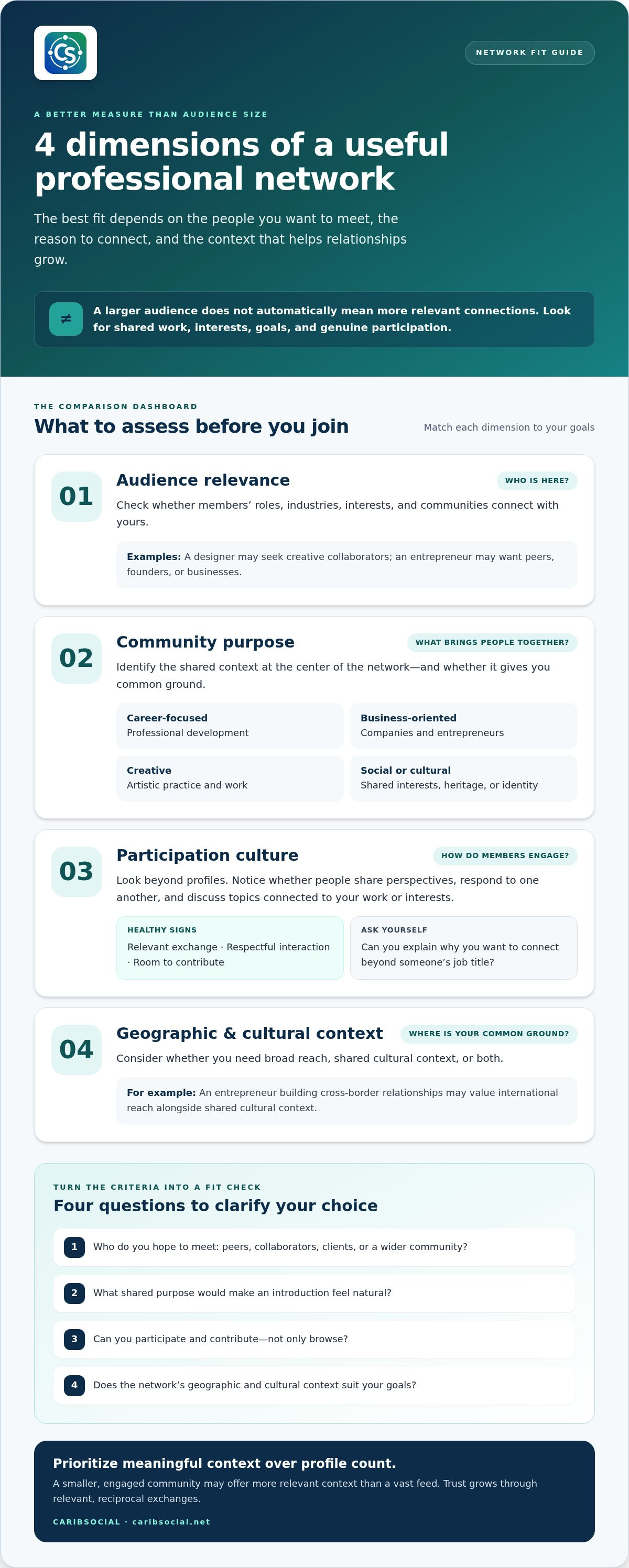
Look for signs of participation, not just a long directory of profiles. Are members sharing perspectives and responding to one another? Do the topics connect with your work or interests? Can you explain why you want to contact someone beyond their job title? Trust grows through relevant, reciprocal exchanges, where both people bring curiosity and value rather than treating each other as entries in a contact list.
Before investing time in a network, consider:
- Relevance: Do members’ work and interests connect with yours?
- Trust: Does the community encourage genuine, respectful interaction?
- Shared purpose: Is there a reason for members to learn, create, or connect together?
- Participation: Can you contribute as well as browse?
Professional networking sites become useful when they turn discovery into connection. A smaller, engaged community may offer more relevant context than a vast feed you only scroll through. Participate with intention: introduce yourself clearly, respond thoughtfully, and find shared ground before asking for someone’s time.
Which criteria help you compare professional networking sites?
Compare the community you’ll enter, not just its tools or the promise of greater visibility. Start with the people you hope to meet and the kind of interaction you want. Someone seeking creative collaborators may value a different setting from a business owner looking for peers or a professional hoping to learn from others in their field.
Compare a network by audience relevance, community purpose, participation culture, and geographic and cultural context, then weigh each against your goals. This checklist helps you judge fit without assuming there is one universal ranking. The strongest match is the one where your priorities align with the community’s character.
Assess the people and communities you want to reach
Get specific about who would make networking meaningful to you. Consider roles, industries, interests, and communities, then look for signs that those people are part of the network. Professionals, entrepreneurs, creators, artists, and businesses may all seek connection, but their reasons for joining and ways of participating can differ.
A focused community can make it easier to find shared ground. A photographer, for instance, may value a space where creative work is part of the conversation, while an entrepreneur may be looking for connections with other founders or businesses. Broad reach is useful when your goals cross industries. If the audience is too broad for your purpose, you may need to spend more time finding relevant people.
Check purpose, participation, and cultural fit
Look at what the community is built around. Career-focused spaces center professional development; business-oriented ones may bring companies and entrepreneurs together; creative communities make room for artistic practice; social and cultural networks connect people through shared interests, heritage, or identity. These contexts can overlap, but they do not all serve the same purpose.
Next, consider how you want to participate. Do you want to exchange knowledge, share creative work, develop business relationships, or connect with a community? Not everyone is seeking job leads, sales, or broad personal visibility. Look for a culture where your contribution feels natural, whether you plan to share expertise, introduce your work, or build relationships around shared interests.
Geography also shapes context. If your goals involve reaching people across borders, consider whether the network brings together an international audience. If local relationships or cultural familiarity matter, look for a community where that context is part of its identity. Global reach and shared roots can complement each other: a network with Caribbean roots, for example, can connect people worldwide while keeping cultural connection at its center.
Use these questions to compare professional networking sites without assuming one community is right for everyone:
- People: Are the roles, industries, and communities relevant to your goals?
- Purpose: Does the network’s focus match the kind of connection you want?
- Culture: Does its style of participation suit how you want to contribute?
- Context: Do its geographic reach or cultural grounding matter to your plans?
If you’re looking for a global network with Caribbean roots, explore CaribSocial’s professional and cultural community as one way to connect across borders.
How do professional networking sites compare across common needs?
Different network types create different paths to connection. Some bring people together around an industry or profession; others offer broad professional discovery, shared-interest communities, or event-based introductions. Comparing the setting helps you decide where you’re most likely to meet people in a way that supports your goals.
These categories are starting points, not rigid boxes. A community can serve more than one purpose, and the same platform may feel different depending on how members use it. The examples below are illustrative, not endorsements or a complete ranking.
| Network type | Primary purpose | Likely connection context | Who may find it useful |
|---|---|---|---|
| Professional associations | Bring people together around a profession or industry | Shared field, practice, or professional identity | People seeking peer connection within a defined line of work |
| Broad networks | Support professional discovery across a wide range of fields | Work history, business interests, or professional identity | People looking to build visibility across industries and roles |
| Interest communities, such as Slack or Discord groups | Connect people around shared interests or ongoing topics | Discussion, knowledge exchange, or a common creative or technical interest | People who want to participate in a focused community |
| Event-oriented platforms, such as Meetup | Help people discover gatherings around shared topics or interests | An introduction linked to a particular event or activity | People who prefer occasional, event-led opportunities to meet |
Compare broad networks with focused professional communities
A broad network creates opportunities to encounter people across industries and roles. That reach may suit someone whose work crosses fields or who wants a more visible professional presence. A focused community offers a clearer shared purpose, which can make conversation easier to start. Industry groups may center on professional practice, creative communities on making and sharing work, and entrepreneurial spaces on building ventures. Cultural communities can connect professional interests with heritage and identity.
Neither model is automatically better. Decide whether you need breadth, a common craft, business-minded peers, or cultural connection. If your goals span several areas, you may benefit from more than one context rather than expecting a single network to do everything.
Choose between online communities and event-led networking
Online communities can support ongoing conversation and repeated interaction. Event-oriented settings have a different rhythm: people meet around a particular gathering, in person or virtually, then decide whether to continue the connection. Meetup is one example of an event-oriented platform, but that format will not suit everyone. Choose an ongoing community if you value regular participation; consider event-led discovery if occasional introductions fit your schedule and style.
Use this comparison as a map, not a verdict. The right professional networking sites for you are those whose connection context matches how you want to meet, learn, collaborate, or belong.
How should you match a professional networking site to your goals?
Start with the connection you want to build, then choose a setting where that relationship makes sense. A clear goal turns browsing into a focused decision: the clearer your networking goal, the easier it is to choose a site whose community and context support it. You do not need to join every platform. Begin with one priority and make time to participate.
Start with the connection you want to build
Do you want to learn from peers, collaborate with other creators, connect with potential clients, find a mentor, or feel closer to a cultural or professional community? Choose one primary goal to guide your first comparison. Other interests can matter too, but a single starting point makes it easier to judge whether a network’s people and purpose are relevant.
Use this four-step process to narrow your options:
- Define a goal. Name what you want to do, such as learn about your field, develop a creative collaboration, increase awareness of your work, or build community connection.
- Identify the people. Think about whose perspective or experience would help: peers, experienced professionals, entrepreneurs, artists, creators, businesses, or people who share a cultural connection.
- Choose a context. Decide whether you prefer a broad professional network, an industry-focused association, an interest-based community, or a space rooted in shared culture or geography.
- Review the fit. Look at the conversations and topics available. Ask whether they connect with your goal and whether you can see a genuine way to participate.
Each goal points toward a different kind of community. Learning may lead you to people who exchange knowledge and perspectives. Creative collaboration calls for common interests and room to share ideas. Business visibility may benefit from a setting where relevant professionals and organizations can encounter your work. Community connection may depend on shared identity, cultural context, or relationships across borders. These are ways to focus your search, not promises of specific outcomes.
Evaluate whether a community feels relevant over time
A quick impression helps, but relevance becomes clearer as you observe. Pay attention to the topics members discuss and how they respond to one another. Do the conversations reflect the interests you came for? Can you add something useful, ask a thoughtful question, or share your perspective without forcing a fit?
Choose a participation habit you can sustain before joining several professional networking sites. You might contribute a considered response or share a useful perspective at a pace that works for you. After participating, ask whether the exchange feels reciprocal and still serves your original purpose. If the community feels aligned, build on those connections. If not, revisit your goal and compare a different context.
If your goals include professional connection alongside Caribbean cultural context and worldwide reach, explore the CaribSocial global network as a place to connect across professional, creative, and community circles.
Why explore CaribSocial as a global professional networking site?
Some professional networking sites connect people through industry or job function. CaribSocial offers another point of context: it is a global professional, social, and cultural network with Caribbean roots. Its worldwide reach brings together professionals, entrepreneurs, creators, artists, businesses, and communities, bringing professional connection and cultural community together.
That combination may matter if you’re looking beyond a purely transactional introduction. Your work is part of your story, along with the places, interests, and communities that shape how you connect. For people seeking relationships across borders, cultural grounding can offer another point of shared context without narrowing the network to one role or purpose.
Connect professional ambition with cultural community
Professional identity and cultural belonging do not have to sit in separate spaces. An entrepreneur may value connections with other business people while also wanting a stronger link to Caribbean culture. An artist may seek creative exchange and community. A professional may want their wider identity to feel welcome alongside their work.
CaribSocial’s Caribbean roots are part of its context, and its reach extends to people and communities worldwide. Members bring different backgrounds, ambitions, and reasons for connecting. Shared cultural context can be a starting point for connection, not an assumption that everyone has the same experience or objective.
Consider how this context relates to the goal you identified earlier. If you want to build professional relationships across borders, ask whether a network grounded in Caribbean culture and connected worldwide feels relevant to the people and perspectives you hope to encounter. If your priority is creative, social, or community connection, consider how those interests relate to your professional life. The fit is personal.
Take a first step into a wider network
Approach exploration with one clear intention. You might want to meet people whose work overlaps with yours, connect with entrepreneurs and businesses, engage with artists and creators, or find a community that brings professional and cultural life together. A defined starting point helps you notice what feels meaningful without expecting one network to serve every need.
Keep your own participation in view as you explore. What perspective could you contribute? Which people would you be glad to learn from or connect with? What does a purposeful connection look like for you, whether exchanging ideas, discovering common ground, or building familiarity over time? These questions can help you enter a global community with curiosity and direction.
CaribSocial brings together professional, entrepreneurial, creative, artistic, business, and community perspectives, rooted in the Caribbean and connected worldwide. If that blend of cultural grounding and global connection speaks to your goals, explore CaribSocial and find your place in a wider network.
Make your next connection purposeful
The right professional networking sites can support more than a single introduction. Choose a place where you can keep showing up, sharing your perspective, and letting professional relationships develop alongside your goals. Start with one genuine interaction, then notice which conversations make you want to return.
If you want a network where professional ambition and cultural connection sit side by side, CaribSocial offers a Caribbean-rooted community connecting people worldwide. Professionals, entrepreneurs, creators, artists, and businesses all belong to its wider network. Start with a clear intention, an open mind, and a willingness to connect across borders.
Explore CaribSocial and connect with a global community, and take the first step toward connections shaped by shared purpose and possibility.
Frequently Asked Questions
What are professional networking sites?
Professional networking sites are online spaces where people make connections related to their work, skills, industries, or professional interests. A photographer, for example, might use one to meet peers, while a small business owner might seek conversations with others in their field. Unlike a personal address book, a networking site can help you discover people you do not already know and find shared ground for a professional conversation.
Which professional networking site is best?
The best choice depends on what you want to do and who you hope to meet. A broad network may suit someone building visibility across industries, while an association or focused community may be more relevant to a particular profession or interest. Look at whether the conversations and member profiles relate to your purpose. A good fit should make it clear how you can participate meaningfully.
Are professional networking sites only for finding a job?
No. Job searching is one possible reason to network, but it is not the only one. People also use professional communities to exchange knowledge, meet potential collaborators, learn about their industry, build recognition for their work, or stay connected with peers. A designer, for instance, might join conversations about creative practice without seeking a new role. Choose a network based on the relationships you want to develop, not a single expected outcome.
Can professional networking sites help entrepreneurs and creators?
Yes. Entrepreneurs can use networking communities to connect with peers, share perspectives, and become more visible to people interested in their work. Creators may value meeting others with complementary skills or interests, such as a filmmaker connecting with a musician to discuss a future project. These platforms can create opportunities for conversation, but results depend on relevance, participation, and how relationships develop over time.
How many professional networking sites should I use?
Start with one network that closely matches your main goal, then consider adding another if it serves a distinct purpose. For example, you might use a broad professional community for visibility and a focused group for ongoing discussion about your field. Joining several sites at once can spread your attention thin. A manageable routine on one or two relevant networks is often more practical than maintaining passive accounts everywhere.
Are professional networking sites useful for connecting across countries?
Yes, they can help people discover professional connections beyond their home country. For cross-border networking, consider whether the community’s interests and cultural context make conversation feel relevant. Be thoughtful about differences in time zones, communication styles, and local working practices. A shared professional interest can be a useful starting point, while respect and curiosity help build understanding across borders. Global reach works best when connection remains personal and purposeful.

