
What if networking could help you build a career and feel more connected to community at the same time? A professional network platform can do more than put contacts in one place, but the differences between networking sites, professional tools, and social networks aren’t always clear. And if every interaction feels like a pitch, making meaningful connections can be hard.
The right network creates space for shared interests, useful conversations, and relationships that grow over time. This guide explains what a professional network platform is, how different network models serve different goals, and what to consider when choosing where to connect. You’ll also learn how professional ambition can sit alongside culture and community, rather than apart from them.
CaribSocial brings professional, social, and cultural connections together in a global network with Caribbean roots. It welcomes professionals, entrepreneurs, creators, artists, businesses, and communities, connecting people across borders while making room for identity and belonging. Whether you’re growing your circle, exploring new perspectives, or looking for a network that reflects more of who you are, understanding the options is a strong place to start.
Key Takeaways
- Understand how a professional network platform supports work-related relationships, discovery, and community beyond a single networking tool.
- Use the relationship-building arc of discovery, shared context, conversation, and follow-through to make connections more relevant.
- Compare broad professional networks, niche communities, and networking workflow tools by purpose, reach, audience, and relationship style.
- Assess whether a network fits your goals by looking for relevant connections, mutual respect, and room for different voices.
- Explore how a Caribbean-rooted global network can bring professional, social, and cultural connections together across borders.
What Is a Professional Network Platform? A Clear Definition
A professional network platform is a digital environment for building and maintaining work-related connections. It brings people together around their professional lives, creating space to discover others, share relevant context, and develop relationships over time. The platform may support a network or community without being a single tool or a fixed set of functions.
That distinction matters. One network may be broad and cross-industry; another may bring together people connected by a field, place, culture, or shared interest. The focus is professional connection, but people don’t leave their wider identities at the door. Work, creative practice, and community can overlap in the same network.
Professional networks are part of the wider idea of a Social Network, where relationships link people to one another. The difference is primarily purpose: a general social network may center on personal sharing, while a professional network is organized around work-related relationships and shared professional context. That doesn’t mean every conversation has to be formal. It means the network gives professional connections a meaningful place to grow.
A professional network platform is the community and connection environment; a contact-management tool is one way to organize information about individual relationships. Keeping that difference in mind helps separate the network itself from the tools someone might use alongside it.
How Is a Professional Network Platform Different from a Networking Tool?
A platform connects people through a wider network or community. A networking tool supports a particular task within or around that network. For example, someone might use contact capture to save a new acquaintance’s details, then use a follow-up tool to remember to reconnect. Those tools can help manage individual relationships, but they don’t by themselves create a community or shared professional setting.
Tools vary, and they aren’t requirements for a platform. A professional network doesn’t automatically include job listings, messaging, events, or customer relationship management functions. Its defining role is to provide an environment for professional connections, discovery, or community, with specific capabilities differing from one network to another.
Who Uses Professional Network Platforms?
People and organizations participate in different ways. Professionals may connect as individuals; entrepreneurs and businesses may engage as organizations; creators and artists may bring their work and perspectives into a wider professional community. Communities, in turn, can bring people together through shared identity, interests, or connections across regions.
One person might be part of a professional circle while also identifying with a cultural or creative community. A global network with Caribbean roots, such as CaribSocial, brings professional, social, and cultural connections together for professionals, entrepreneurs, creators, artists, businesses, and communities worldwide. The value begins with relevant shared context, not a promised job, sale, or specific result.
How Professional Network Platforms Turn Shared Interests into Connections
A useful connection rarely begins with a contact count. It starts when people have a reason to notice one another, a point of context for reaching out, and enough mutual interest to keep the conversation going. A professional network platform can make that process easier by bringing people into a shared professional or community setting. The relationship still grows through what people say and do.
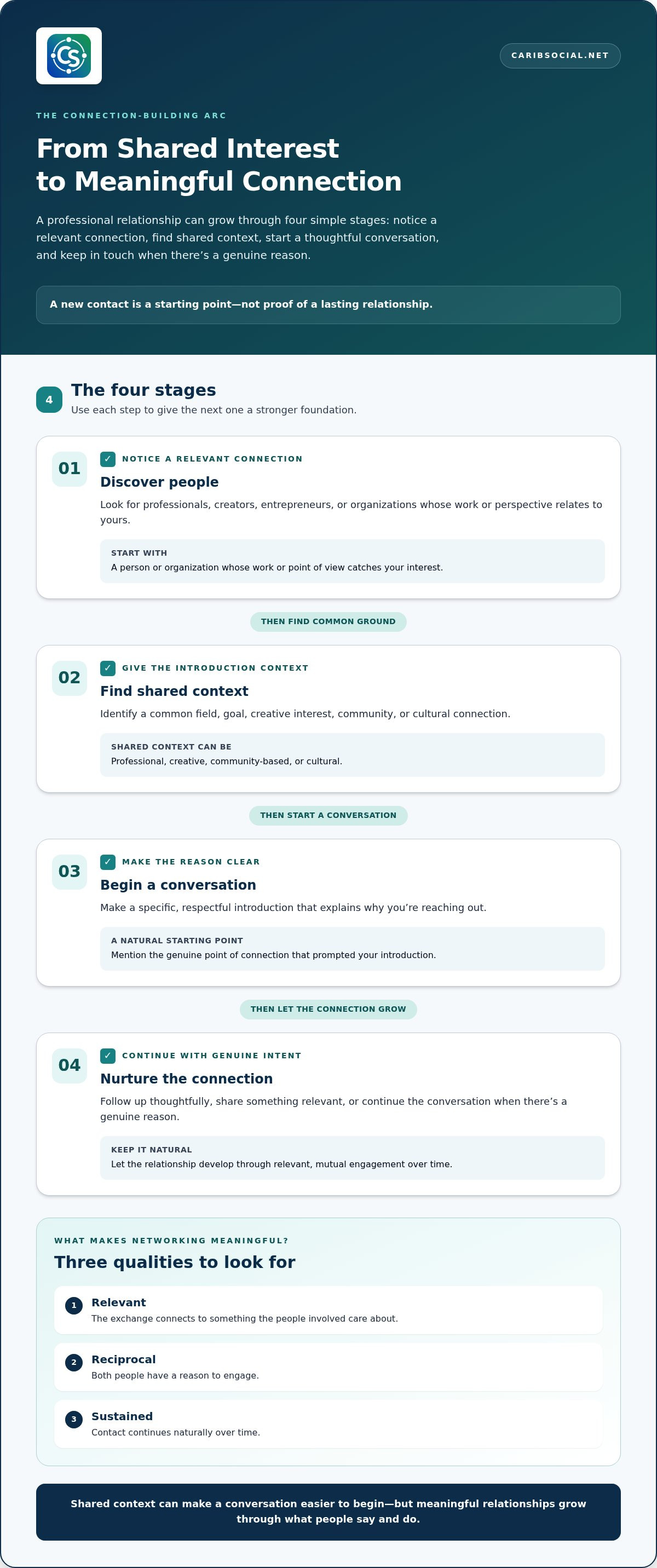
Think of connection as an arc:
- Discover people: Notice professionals, creators, entrepreneurs, or organizations whose work or perspective relates to yours.
- Find shared context: Identify a common field, goal, creative interest, community, or cultural connection.
- Begin a conversation: Make a specific, respectful introduction that explains why you’re reaching out.
- Nurture the connection: Follow up thoughtfully, share something relevant, or continue a conversation when there’s a genuine reason.
Each step gives the next one a stronger foundation. A new contact is a starting point, not proof of a lasting relationship. Meaningful professional networking is reciprocal, relevant, and sustained: both people have a reason to engage, the exchange connects to something they care about, and contact continues naturally over time.
Why Relevance and Shared Context Matter
Shared context gives an introduction a human starting point. Two people may work in the same industry, care about a similar creative practice, or belong to a community with ties across countries. These connections don’t guarantee agreement or opportunity, but they can make it easier to explain why a conversation feels worthwhile.
Instead of sending a generic greeting, mention the genuine point of connection: a topic you both follow, a professional interest, or a community perspective that prompted your introduction. This helps the exchange feel more natural without turning it into a script. Cultural identity can also be meaningful context, giving people room to connect through heritage as well as work.
From First Contact to an Ongoing Professional Relationship
Trust takes time. After an initial conversation, follow up with a brief note that reflects what you discussed. Share a useful resource, acknowledge someone’s work, or check in when you have a relevant reason. Be considerate of their time, listen as well as contribute, and leave space for the other person to respond at their own pace.
Look for signs of mutual interest: both people ask questions, contribute ideas, or make an effort to continue the exchange. If only one side is consistently reaching out, let the connection breathe. Platforms can create opportunities to meet and reconnect, but they can’t guarantee trust, collaboration, employment, or business. Those outcomes depend on people and circumstances.
For professionals who value both work and community, a network rooted in shared identity can offer meaningful context alongside a global outlook. Explore CaribSocial’s global network as one place where professional, social, and cultural connections come together.
Professional Network Platform Models: Compare Purpose, Community, and Reach
Platforms differ in the kind of connection they’re designed to support. Some bring professionals from many fields into a broad network. Others gather people around a shared practice or community, while separate tools help users organize networking tasks. Comparing purpose, community scope, relationship style, and audience offers a clearer guide than comparing feature lists alone.
The categories can overlap. A broad network may include focused communities, and a niche platform can connect people across locations. No single model serves every goal. Use these distinctions as a starting point, then consider where you want to connect and what kind of conversations you hope to build.
- Broad professional networks: Their central purpose is professional discovery across fields. They bring together a wide, varied audience, where relationships may begin through work identity or shared interests. They can suit professionals and organizations seeking connections across roles or regions, though it may take more effort to find the most relevant conversations.
- Niche communities: These bring people together around a shared field, interest, or goal. Their scope is more focused, and relationships often grow from that common context. They can suit people seeking peer exchange, while their narrower focus may offer less variety than a broad network.
- Networking workflow tools: These support specific tasks, such as organizing contacts or planning follow-ups. Their reach depends on the user’s existing network, and their style is task-focused. They can help individuals manage connections, but they aren’t a community or network in themselves.
Broad Networks, Niche Communities, and Networking Tools
A broad professional network is designed to support discovery among people with varied professional backgrounds. Its wide pool can offer different perspectives, but reach alone doesn’t establish relevance or belonging. You’ll still need to identify which conversations fit your interests.
A niche community centers on shared context. Indie Hackers, for example, represents a founder community, while Contra is an example associated with independent work. These examples show distinct professional orientations, not a universal ranking. A focused setting can make common ground easier to recognize, while its scope is narrower by design. Workflow tools remain separate: contact capture or follow-up support can help you manage relationships, but doesn’t create a professional network.
Which Platform Model Fits Different Professional Goals?
Start with what you want from your network, then consider which model fits:
- Broad discovery: Consider a broad network if you want to encounter people across professions, organizations, or regions.
- Peer community: Look toward a niche community when shared experience or a particular field matters most.
- Independent work: Explore platforms oriented toward independent professionals, with Contra as one example of a focused professional context.
- Creative connection: Seek a community where creative practice and professional identity can meet, rather than assuming every broad network will reflect both.
Also consider how you prefer to connect. Do you value varied perspectives, a close sense of shared purpose, or help organizing existing relationships? Your choice may involve more than one model. A global professional network with cultural roots can bring work and community into the same space, offering context beyond reach or workflow support alone.
How to Assess Whether a Professional Network Feels Useful and Authentic
A network can look busy and still feel like the wrong place for you. A large audience or frequent activity doesn’t tell you whether its community reflects your interests, values, or professional direction. Assess fit by looking beyond reach: consider who the network brings together, what context connects them, and whether you can imagine contributing as yourself.
Use this short sequence to make the decision more intentional:
- Define your purpose. Decide what you want from the network, such as learning from peers, connecting across industries, or sharing your creative work.
- Identify your community. Consider which professional, cultural, geographic, or interest-based contexts matter to you.
- Assess relevance. Look at whether the network’s stated purpose and community seem connected to the people and conversations you value.
- Reflect on fit. Ask whether you feel able to take part with curiosity and respect, without having to set aside important parts of your identity.
These questions help you judge a professional network platform by its human context, not just its apparent size. You don’t need every member to share your background or goals. What matters is whether the network makes room for relevant connections, mutual respect, and varied voices.
Questions to Ask About Community Fit
Start with the community’s stated focus. Does it bring together people whose professional interests or shared context feel relevant to you? Do its descriptions leave room for different roles and perspectives, or does the intended audience seem narrowly defined? These questions help you understand what a network is meant to connect without assuming it offers particular tools or functions.
Then consider whether both work and community identity can belong. A creative professional, for example, may value a network where their practice and cultural connections can coexist. Look for a purpose that resonates with you, rather than treating a feature list as proof of belonging.
Recognizing Relationship Quality Beyond Contact Counts
Connection quality shows up in the nature of interactions. Notice whether people exchange ideas with consideration, respond to one another’s perspectives, and return to conversations when there’s a genuine reason. A large audience may broaden discovery, but it doesn’t automatically create trust, relevance, or sustained professional relationships.
Choose intentional participation over collecting names. Contribute thoughtfully, acknowledge what others share, and reach out when you can explain the shared context behind your introduction. Over time, reciprocity and ongoing conversation can be more telling than activity totals. A quieter network may suit you better if its relationships feel relevant and welcoming.
If you’re looking for a network where professional life can sit alongside cultural identity and community, explore CaribSocial’s global network. With Caribbean roots and a worldwide focus, it brings professional, social, and cultural connections together.
CaribSocial: A Caribbean-Rooted Professional Network with a Global Outlook
Professional connection can be stronger when it leaves room for the whole person: their work, creative interests, cultural identity, and community ties. CaribSocial brings these dimensions together as a global professional, social, and cultural network with Caribbean roots. Its focus connects a distinct sense of heritage with a worldwide community outlook.
That combination gives CaribSocial a clear place among professional networks. It isn’t defined only by career identity or by geography. Caribbean roots inform the network’s perspective, while its global focus connects people and communities across borders. The result is a space where professional and community identities can coexist, and where connection can begin from more than one shared point of reference.
A Network Connecting Professional and Cultural Community
People don’t experience their lives in separate categories. A professional may also be an artist, an entrepreneur may be part of a cultural community, and a business may be connected to people across regions. A professional network platform that recognizes these overlaps can offer a broader context for connection than work identity alone.
CaribSocial connects professionals, entrepreneurs, creators, artists, businesses, and communities worldwide. Its Caribbean roots are central to its identity, but its outlook is global. The network brings people together across borders without defining participation as limited to Caribbean-based users. This balance matters for people who want professional connection to reflect culture and community, too.
Shared identity can add context to a connection, but it doesn’t make every person’s experience the same. A welcoming network makes room for varied perspectives and ways of participating. That means professionals and creatives can bring their distinct interests into a wider community, while businesses and organizations can be part of the same broader ecosystem. The emphasis is connection, not a guaranteed result.
Take the Next Step into a Global Network
CaribSocial may resonate with people who want their professional lives to connect with social and cultural belonging. Professionals can value a wider community context; entrepreneurs and businesses may appreciate a network that brings different kinds of people together; creators and artists can see professional and creative identity as naturally connected. Communities, too, can take part in a global network with Caribbean roots.
Consider what you want your network to reflect. If you’re looking for connection that can hold professional ambition alongside culture, identity, and community, CaribSocial offers a distinctive global perspective. Its roots are Caribbean, and its community outlook reaches across borders.
Explore CaribSocial and become part of its global network of professionals, entrepreneurs, creators, artists, businesses, and communities.
Choose a Network That Reflects Where You’re Going
Your next step is to be intentional about the spaces where you invest your time and perspective. Consider what you want to contribute, whose voices you hope to encounter, and whether your professional life can sit comfortably alongside the parts of your identity that matter to you. The right fit isn’t simply the place with the most activity. It’s a place that feels aligned with the community you want to help shape.
For people seeking a professional network platform where culture and connection share space, CaribSocial offers a distinctive point of view: Caribbean roots with a worldwide community focus, bringing professional, social, and cultural connections together in one network. Take a moment to explore the community and see whether its global outlook feels right for your next chapter.
Explore CaribSocial and connect with a global community. Your next meaningful connection can begin with showing up as yourself.
Frequently Asked Questions
Is a professional network platform the same as a social network?
It’s a type of social network, but its emphasis is professional connection. People may share career-related ideas, discuss their field, or learn about others’ work, while a general social network may focus more on personal updates. The categories can overlap: someone might share a work milestone with friends or discuss an industry topic in a professional community. The difference is the network’s main purpose, not a strict boundary between work and personal life.
Can a professional network platform help entrepreneurs and creators connect?
Yes. Entrepreneurs can use professional communities to exchange perspectives with peers, while creators can connect around their craft, audience, or working practices. For example, an independent illustrator might introduce themselves to other creative professionals by discussing a technique or project challenge. That shared subject can open a conversation, though it doesn’t guarantee a partnership, client, or sale. The best starting point is a genuine contribution, not an immediate pitch.
What is the difference between a professional networking platform and a networking tool?
A professional network provides a setting where people can discover and engage with one another; a networking tool helps with a specific task. For instance, a digital address book can store someone’s details, and a reminder app can help you remember to follow up. Those tools can support your routine, but using them doesn’t automatically connect you to a professional community or give you shared context.
How do I know whether a professional network is relevant to my goals?
Check whether its intended audience and focus align with what you want to do. If you’re seeking peer insight on a design practice, a community centered on creative work may feel more relevant than a broad space where that topic is harder to find. Also consider whether you’d feel comfortable contributing. A useful fit gives you a clear reason to participate, not just a large collection of profiles to browse.
Are professional network platforms only for finding jobs?
No. People also use professional networks to learn from others, share ideas, stay connected to a field, and take part in communities related to their work. A small-business owner might seek perspectives from peers, while an artist may want to join conversations about creative practice. These connections can be valuable in their own right. A professional network isn’t the same as a recruitment or job-placement service.
Can a professional network connect people across countries and cultures?
Yes, a network with a worldwide outlook can bring people together across borders and cultural backgrounds. CaribSocial is a global professional, social, and cultural network with Caribbean roots, connecting people and communities worldwide. For someone working across countries or maintaining ties to a cultural community, that broader context can make it easier to encounter perspectives beyond their immediate location, while each relationship develops through individual conversation.
What makes a professional network feel authentic rather than transactional?
Authentic networking treats people as more than possible opportunities. Notice whether conversations include curiosity, attentive responses, and an exchange of ideas, rather than a rushed request or repeated sales pitch. For example, responding thoughtfully to someone’s perspective before asking for anything keeps the interaction human. You can contribute without expecting an immediate return, while still being clear about your interests and respectful of others’ time.

