

What if the connections that move your career forward are also the ones that help you feel at home? Professional and social networking can work together, even when networking feels transactional, awkward, or hard to maintain. Strong relationships rarely begin with a pitch. They grow through shared interests, genuine conversation, and a sense of belonging.
It can be tricky to balance your professional and personal identities online, or to find communities that reflect both your background and ambitions. This guide explains how professional networking and social networking differ, where they overlap, and how to participate with purpose while staying true to yourself.
You’ll find practical ways to build authentic connections, maintain them over time, and choose communities where work and social life can complement each other. We’ll also look at how a culturally rooted, globally connected network can broaden your horizons. With Caribbean roots and connections spanning communities worldwide, CaribSocial brings professional, social, and cultural connection into one wider community context for professionals, entrepreneurs, creators, artists, businesses, and communities.
Key Takeaways
- See how professional and social networking can complement each other, connecting career goals with shared interests and community belonging.
- Learn why trust, mutual recognition, and consistent participation can matter more than a large contact list or a highly visible profile.
- Compare professional-only, social-only, and integrated networks to find the spaces that fit your goals and preferred way to connect.
- Use a four-step approach to participate with purpose and set boundaries around what you share.
- Explore how CaribSocial brings Caribbean roots and a global community of professionals, entrepreneurs, creators, artists, businesses, and communities together.
What Do Professional and Social Networking Mean Together?
Networking can mean building a career, making friends, finding people who share your interests, or feeling part of a community. These purposes can overlap. A conversation that begins around music, culture, or a shared project may lead to an exchange of expertise. A professional connection can also become more meaningful when people understand one another’s interests and experiences.
Professional networking is relationship-building around work, expertise, collaboration, and career learning. It might involve exchanging ideas with someone in your field, learning from a more experienced peer, or finding a collaborator with complementary skills. Social networking centers on connections through shared interests, identity, culture, and everyday community. For a foundational overview of how people form and maintain connections, see Understanding Social Networks.
How is professional networking different from social networking?
The main difference is often the purpose of a particular interaction, not the kind of person you need to be. In a professional setting, you might discuss a project, an industry insight, or a skill you’re developing. In a social setting, the conversation may grow from a cultural connection, creative interest, or community. Yet a professional relationship can begin socially, and a social connection can lead to learning or collaboration.
For example, two people might meet through a shared interest in Caribbean arts. Their first conversations may be about creators and cultural events, then turn to a creative project or a skill they want to develop. Neither person has to force a business pitch or hide their professional experience. The relationship can develop at a natural pace, guided by what both people genuinely want to share.
Why can one network serve both purposes?
One network can make room for different kinds of connection because people bring more than a job title or personal interest to a relationship. A designer may also be a mentor, parent, musician, or active member of a cultural community. Recognizing these different dimensions can make it easier to find shared ground and approach conversations with curiosity.
Repeated, genuine interaction builds familiarity before a specific opportunity arises. People who exchange ideas, recognize one another’s contributions, and show up consistently can develop trust without treating every conversation as a transaction. Cultural context can also make interactions feel more welcoming and relevant. Shared references, traditions, or experiences may offer a comfortable starting point, while a globally connected community can bring different perspectives into the conversation.
That balance is the heart of professional and social networking: ambition and belonging can strengthen one another without making every connection serve the same purpose. A useful way to remember the distinction is: Professional networking connects people through work and learning; social networking connects them through shared life and interests; both grow through genuine relationships.
How Professional and Social Networks Build Lasting Value
A useful network isn’t measured by the number of names in your contacts or how often your profile is seen. Its value grows through trust: people share relevant knowledge, recognize one another’s contributions, and keep showing up with care. A thoughtful exchange may help someone see a challenge differently. A conversation sustained over time may create room for learning, collaboration, or a stronger sense of community. These outcomes depend on the relationships people build.
Consistency doesn’t mean being constantly online. It can be as simple as responding with a considered comment, sharing a resource that fits someone’s interests, or following up after a useful conversation. Small, genuine interactions give people a clearer sense of one another than a stack of brief introductions or a stream of likes alone.
What makes a professional connection meaningful?
A meaningful connection offers attention as well as access. You might exchange expertise with a peer, share an insight that helps someone understand an industry shift, or introduce two people whose interests genuinely align. Reciprocity is part of this exchange, but it isn’t a ledger. It means showing mutual respect and contributing when you can, without expecting every gesture to be repaid equally.
Care for the relationship after the first introduction. Remember what someone is working toward, check in when you have a relevant reason, and share ideas or opportunities that match their interests. A brief, personal follow-up is more considerate than a generic message sent only when you need a favor. For example, refer to a point from your conversation and share one relevant resource, rather than sending a vague “Let’s keep in touch.” Over time, these exchanges can build familiarity and create a foundation for collaboration, learning, or support.
Where do culture and shared interests fit?
Shared interests and cultural references give people an easy place to begin. A conversation might start with a creative form, a community concern, or a familiar tradition, then develop into an exchange of skills and perspectives. The connection can include professionals and entrepreneurs, as well as artists, creators, and community members. Each person brings more than a job title, and the range of experiences in a network can broaden what people learn from one another.
For a closer look at how these spaces bring people together, explore this professional network platform guide. A network’s lasting value comes from what people build through it: familiarity, shared understanding, and reciprocal participation. Sustained, reciprocal interaction gives a network value because trust and mutual understanding grow through what people contribute over time.
If you’re looking for a place where professional ambition and community connection can coexist, explore CaribSocial’s global network, rooted in Caribbean culture and connecting people worldwide.
Professional-Only, Social-Only, or Integrated Networking?
Different networks create different expectations. A focused professional space may suit conversations about expertise or career learning. A social community may feel more natural for everyday interests and cultural connection. An integrated network brings these purposes into a shared environment, which can suit people whose work, creativity, and community life intersect. To choose a good fit, consider the conversations you want to have, the people you hope to meet, and how much overlap you want between your professional and personal interests.
| Network type | Primary purpose | Typical interactions | Potential strengths |
|---|---|---|---|
| Professional-only | Work identity, expertise, and career-related exchange | Discussing industry ideas, sharing skills, and connecting around work | A clear context for professional conversations and learning |
| Social-only | Personal interests, everyday conversation, and community | Sharing experiences, discussing common interests, and engaging socially | A relaxed setting for connection around shared life and interests |
| Integrated | Professional, social, and cultural connection together | Connecting through work, creative interests, culture, and community | Room for different parts of a person’s identity and interests |
What are the strengths of purpose-specific networks?
A clear focus helps people understand what kinds of participation to expect. In a professional-only space, members can foreground work identity, expertise, and career-related exchange. A social-only space may put less emphasis on professional credentials and more on interests or community conversation. This focused context can help when you have a specific goal or audience in mind, though it won’t suit every person or every kind of connection.
For example, someone looking for peer discussion about a particular field may prefer a dedicated professional setting. Someone hoping to connect around a hobby may choose a social community where that interest is the shared starting point. Neither choice has to be permanent. People can participate in different spaces for different reasons, adjusting their approach to fit the context.
When can an integrated network feel more relevant?
An integrated setting may feel relevant when professional interests are closely tied to culture, creativity, or community. An artist may want to share their work while also connecting through cultural identity; an entrepreneur may value conversations that include both business and community perspectives. Cultural context can add meaning to a professional identity without replacing it. A broader environment can give people more ways to find shared ground.
CaribSocial is a global professional, social, and cultural network with Caribbean roots, connecting professionals, entrepreneurs, creators, artists, businesses, and communities worldwide. That combination reflects how people participate across different parts of life, while leaving room for work-related interests and cultural belonging. For a separate guide to assessing professional-focused options, explore professional networking sites.
As you compare spaces, consider the conversations you want to have, the people you hope to learn from, and the aspects of your identity you want to bring forward. Professional and social networking don’t have to compete. You might choose a focused space for a particular exchange and a broader community when you want professional, social, and cultural connections to sit side by side.
How to Participate Without Losing Authenticity or Boundaries
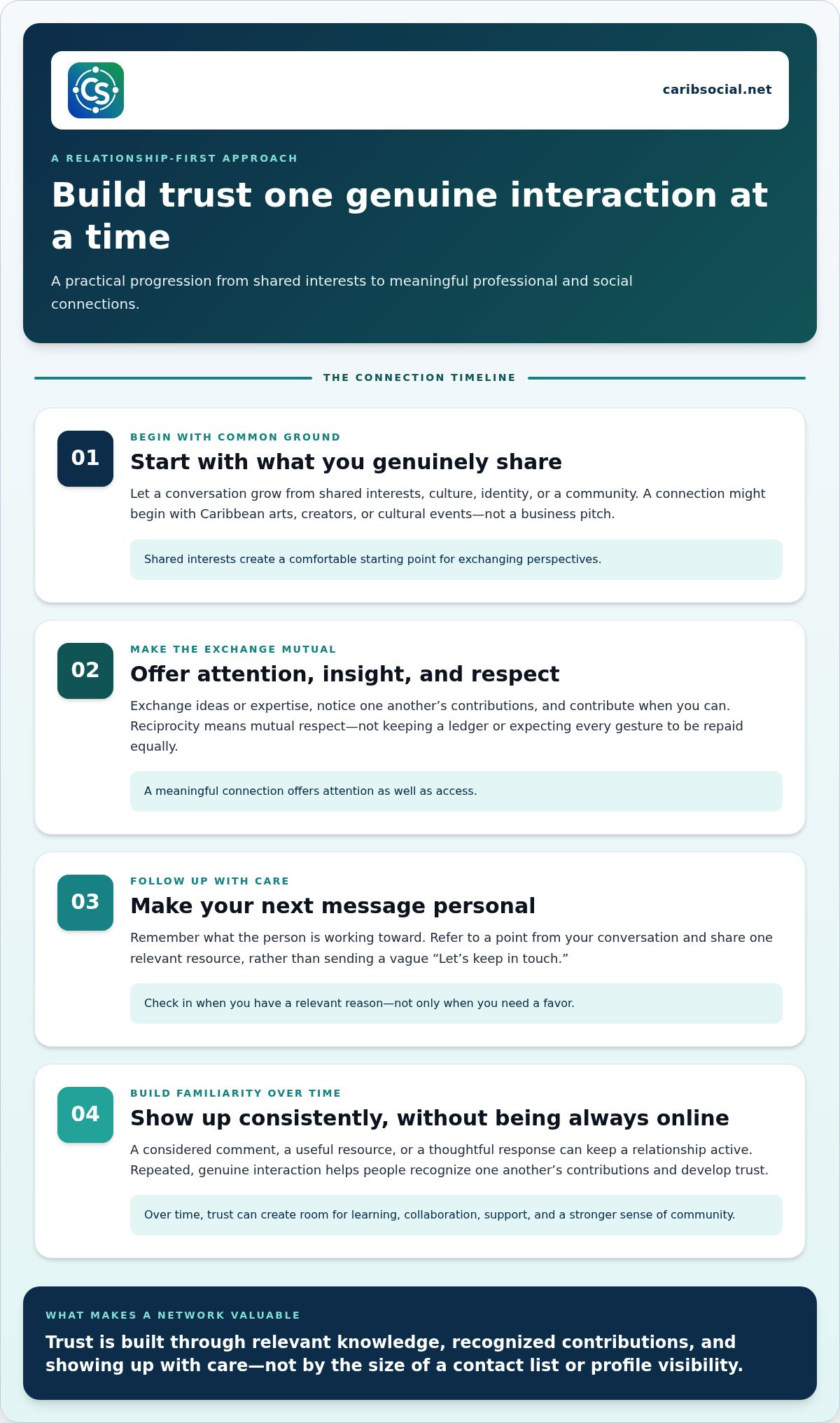
Purposeful networking doesn’t require sharing everything about yourself or turning every interaction into a career move. You can be present, generous, and genuine while deciding what belongs in public and what you’d rather keep private. Use this four-step framework to make professional and social networking feel more natural and sustainable.
- Set an intention. Decide what you hope to learn, share, explore, or contribute. A realistic aim might be to understand a creative field better or join conversations around a community interest, rather than turning every new connection into a business lead.
- Shape a clear presence. Make your profile accurate and relevant to the people you want to connect with. Explain what you do or care about in language that feels like you, and choose deliberately which personal details to share in each space.
- Contribute thoughtfully. Ask a question that advances the conversation, share work or insight that’s relevant to the community, and recognize someone else’s useful contribution. Add context or encouragement rather than posting simply to be seen.
- Nurture relationships. Follow up when there’s a genuine reason, remember what people have shared, and stay engaged at a pace you can maintain. A considered message or relevant resource can keep a connection warm without requiring constant posting.
How do you set a networking intention?
Start by naming one or two things you want from a community: perhaps learning from people with different experience, sharing your creative work, or finding others who care about the same cultural or social topics. Then look for spaces and conversations that align with those interests and values. Keeping your aim specific helps you participate with curiosity instead of approaching each person as a potential opportunity.
How can you balance visibility with personal boundaries?
Visibility is a choice, not an obligation to disclose your whole life. Keep public profile details clear, accurate, and useful to your intended audience, then decide which personal topics belong in particular spaces or conversations. You can share a professional perspective without revealing private details, and take part socially without making every post about work. Consistency and respect matter more than constant updates or self-promotion.
Boundaries can also change with context. Before posting, consider who may see it, whether it adds to the conversation, and whether you’re comfortable with it representing you beyond that moment. It’s fine to listen before joining in, keep some parts of your life offline, or step back when participation no longer feels right. For practical ideas on cultivating relationships across borders, explore this guide to building professional connections worldwide.
Choose a sustainable pace and level of openness, then bring that intention into a community where professional, social, and cultural connection can coexist. Explore CaribSocial’s global network and find space to participate in a way that feels purposeful and true to you.
How CaribSocial Connects Professional and Social Communities
Professional ambition and cultural belonging can share the same space. CaribSocial is a global professional, social, and cultural network with Caribbean roots, connecting people and communities worldwide. Its identity brings a distinct cultural grounding to a worldwide network, creating room for conversations shaped by work, creativity, shared interests, and community life.
People rarely experience their professional and social worlds as entirely separate. A creator may bring cultural perspective to their work. An entrepreneur may value community connections alongside professional exchange. An artist may be interested in both creative collaboration and the people who shape a cultural scene. These dimensions can inform how people connect without defining every interaction or limiting what someone can contribute.
What does a Caribbean-rooted global network add?
Caribbean roots offer a meaningful cultural point of connection within a worldwide community. Shared references and cultural experiences can give people a welcoming place to begin, while the network’s global reach creates space for connection across locations and backgrounds. Those roots provide context, not a boundary around who can participate. People can engage through professional, creative, social, and cultural interests, whether those interests overlap or stand on their own.
This breadth supports a more layered view of community. A conversation might begin with a shared cultural interest and move toward professional ideas, or start with someone’s expertise and grow through common interests. Neither path needs to be forced. People can choose conversations that feel relevant and bring forward the parts of their experience they want to share.
Who can find a place in the CaribSocial community?
CaribSocial brings together professionals, entrepreneurs, artists, creators, businesses, and communities. Each contributes a different perspective: professionals bring knowledge from their fields, entrepreneurs share the realities of building ventures, artists and creators add creative expression, and communities connect people through shared interests and identity. These roles can overlap, too. Someone may be a business owner and an artist, or a professional active in community life.
The value is in making space for that range without reducing people to a title or expecting every interaction to lead to a transaction. People can explore ideas, recognize one another’s work, and take part in conversations that reflect their interests. In this way, professional and social networking becomes part of a broader community experience, shaped by cultural context as well as individual purpose.
Start with a simple intention: choose the conversations you want to join, contribute in a way that feels genuine, and let connection develop at its own pace. Explore CaribSocial and discover a network connecting communities worldwide.
Make Your Next Connection More Intentional
Your next meaningful connection doesn’t need to begin with a perfect introduction or a polished pitch. Start with curiosity: join a conversation, share a perspective, or recognize someone’s contribution. A small, genuine action can help you take part in professional and social networking in a way that reflects your values, without making every interaction feel like an ask.
Think of your network as something you help shape through the ideas and experiences you bring to it. CaribSocial is a space where Caribbean roots meet a worldwide community, and where professionals, entrepreneurs, creators, artists, businesses, and communities can connect across professional, social, and cultural interests. Your contribution adds another perspective to that shared space.
Explore CaribSocial and connect with a global community. Bring your interests, your experience, and the boundaries that feel right for you. The connections you build can start with one thoughtful exchange and grow in a direction that feels authentic.
Frequently Asked Questions
What is professional and social networking?
Professional and social networking brings work-related relationships and connections through interests, culture, or community into a shared experience. For example, a person in an arts group might exchange creative ideas while also learning about someone’s professional skills. Each connection can have its own purpose. Notice what the conversation calls for, then take part with genuine interest rather than forcing it toward a particular outcome.
Can social networking help with professional connections?
Yes. Social interactions can help people become familiar with one another before a work-related topic comes up. A thoughtful comment in a design community, for instance, can lead to a conversation about creative practice or shared challenges. Keep the setting in mind: a personal discussion doesn’t automatically need a professional pitch. Let people learn about your interests naturally, and share work details when they’re relevant to the conversation.
Is professional networking only for finding a job?
No. People also use professional connections to learn a skill, compare approaches to a work challenge, or exchange feedback on a project. A freelancer might ask peers how they handle a common client request, while an experienced colleague could share a resource that helps someone grow in their field. If employment is your goal, say so clearly, but don’t assume every professional conversation needs to lead to a job opportunity.
How do you start networking if you feel uncomfortable?
Begin with one manageable conversation. You might introduce yourself by saying, “I’m exploring community arts projects and would love to hear what you’re working on.” Then ask a question based on the other person’s response instead of trying to prepare a perfect pitch. Listening is a valid way to participate, too. Give yourself time to become familiar with a group before deciding how actively you want to engage.
What is the difference between a professional network and a social network?
A professional network generally makes work, expertise, and career learning central, while a social network often revolves around interests, community, and everyday interaction. The practical difference is the context: consider what members usually discuss and what kind of contribution feels appropriate there. You can take part in both types of space, adjusting what you share to fit the conversation without treating your professional and personal identities as completely separate.
Can a networking community connect people across countries and cultures?
Yes. Online communities can bring people into conversation across borders, though meaningful connection takes more than a shared digital space. For example, a group collaborating across time zones may benefit from clear communication about timing and from asking rather than assuming how a cultural reference will be understood. Curiosity helps people learn from differences, while shared interests or goals can offer common ground for an exchange to begin.
How can you network online without seeming overly self-promotional?
Make your contributions useful to the conversation rather than turning each post into an advertisement. Share a project when it relates to the topic, explain what you learned from it, or ask for a specific perspective. You can also recognize someone else’s work without attaching a pitch of your own. Before posting personal details, consider who may see them and whether you’re comfortable sharing them in that setting.


